Wednesday, June 26, 2013

Student-Run Productions: Teaching "Real World" Skills with Theater


As I looked around my classroom, I saw students hard at work at a variety of tasks. The actors and their coaches met in the corner going over lines, while the set designers built a castle out of cardboard boxes and butcher paper. At the same time, members of the media were floating around interviewing their peers about the production of the play while the drama critics took notes about how the production was coming together.
IMG_20130410_123103.jpgWhat was I doing, one might wonder? In all honesty, not much. Call me crazy (or maybe just lazy), but this is what I think education is supposed to be. Teacher as facilitator and guide, not deliverer of information. In ten years, they won't remember much if anything that came out of my mouth, but hopefully they will remember the dress they sewed, or the time they were able to be the director of a student production.
During the third quarter of this year, my class of 6th grade students put on a student-run production of a play adaption of The Emperor's New Clothes, and it was one of the greatest teaching experiences of my life. After reading the play and analyzing its admittedly thin literary merits, I helped define the roles of the student run production, to let the students know where they might be headed. I did my best to differentiate the roles, so that my silent student could work one on one with an actor as an actor coach, and my student with dysgraphia could spend his time building a set. We had a student director, members of the media, drama critics and costume designers as well. The students had to write a persuasive letter (using persuasive strategies learned earlier in the year) to convince me (the producer) what role they should be in the production. After their letters, they were assigned roles in the production based on their desires and the quality of their argumentation.
A couple of things surprised me, though they should not have. First of all, the diversity of student interests was incredible. I rarely had to give anyone their second choice, and almost everyone got the exact role they wanted. We spend all day as teachers trying to fit our students into a certain shaped (too often a standardized test shaped) box that we forget just how diverse their interests and abilities are. We should look at the world around us and realize that the diversity of careers must have resulted in a diversity of interests and abilities, I hope not to forget that as a teacher. This brings me to my second point. The work of the students was of such high quality, I saw futures for many of them in theater production if they so chose. When motivated, they could create some incredibly high quality work. I always preach on giving students choices in their learning, and teaching standards while allowing them to do something that really matters to them, and this was just more fuel to the fire.
The students worked without much prodding or cajoling by the teacher. The student director kept them on task, and the students wanted the play to be well done because they were in charge of something that interested them. I saw students become empowered to lead, to create, to try out new ideas, and throughout the process it was a beautiful thing to see.
Of course their were writing components of the play (persuasive letter arguing for a role, reflective piece analyzing their own contributions to the production) and reading components (character analysis of different characters, historical context analysis of the setting), but the most important skills taught were those of critical thinking, working in teams (they were given self and peer evaluations), time management (the show must go on!) and the ability to be proactive. I hope these are the skills with which my students leave the classroom, these are the skills they will really need in the real world.
This might sound like a nightmare for many teachers. The teacher was not the center of attention and the teacher was making decisions about the production. It took some planning and scaffolding on the front end, but once I set the machine in motion, it was incredible how student sustained it was. I was in essence along for the ride, facilitating their planning, answering questions as they came up. It might not have looked like teaching in the traditional sense, but after reading their reflections, I know they may have just learned more with me in the backseat rather than me driving the bus.

Friday, March 1, 2013

Teaching the Holocaust: Middle School Students' Experiential Learning

When I was in 7th grade, I had an amazing English teacher. Ms. Mote was her name and she, along with many other amazing teachers, are a huge part of why I became one. We read and performed A Midsummer Night's Dream (I was Puck, unsurprisingly), she taught me about archetypes and the hero cycle, but the most lasting learning experience I remember was what she called the Blue Dot Project.
In this project, students were given a blue dot, and for a week or so, they had to wear the blue dot and were restricted to talking with only other Blue Dots, and had many privileges and rights taken away during class. This was done in order to mimic the treatment of the Jewish population during the Holocaust. While this project went on, we read MAUS, by Art Spiegelman. This is a Pulitzer Prize winning graphic novel about a son interviewing his father about his time in Nazi Poland and how he survived the concentration camps. The imagery, symbolism, and emotion in the book present a very difficult subject in a manner that is fun and easy to read. The work is powerful and exciting, and although a little racy for 6th grade, is the right compliment to the Blue Dot project.
This year, I made the choice to read the MAUS (not without some parent uproar over the content, which includes Postpartum Depression, suicide, and an insinuation or pre-marital sex) and do our own version of the Blue Dot project. I had students randomly assigned to be "Blue Dots," and for one class period, they were made to sit on the floor, while their books and pencils were taken and given to students who forgot theirs, and they weren't allowed to use the bathroom, or even answer questions. They were still expected to complete the day's assignment on time, despite their disadvantages. I asked the other students to report to me if they saw any of the Blue Dots speaking, and would reward the reporting students with chocolates, while punishing the Blue Dots with further isolation.
The results were fascinating. Within minutes, the students knew what I was doing (I made it clear that it was an experiment so as not to upset our very concrete thinking 11 year olds), and yet many of them were quick to take on the same roles of the characters in the book we read about. Several of the Blue Dots were quiet and depressed, while others resisted. The non-Blue Dots, almost without exception, took on the many roles played by the non-Jewish German and Polish citizens during the Holocaust, just as they were presented in the book. Some students attempted to help the Blue Dots, sneaking them paper, pencils, even food when I "didn't see," or complained to me that it wasn't fair what I was doing. Other students took on the roll of the Nazi conspirators when seeing the reward and were hawks as they watched the Blue Dots, not allowing them to do anything I had instructed them not to do. The pleasure that some students took in being in a position of relative power was mesmerizing and frightening, and gave me a unique look into how the environment of Nazi Europe could have been created.
At the end of class, we debriefed the experience. I asked the students about how they felt about me, the Blue Dots, and the non-Blue Dots. Their words gave life to the complex emotion, action, and inaction of a society where violent and pervasive discrimination was literally the law of the land. Some students were able to experience the helplessness and self-loathing of one who is discriminated against, while most students felt the guilt and power of those who of no fault of their own, find themselves on the better side of the prejudicial practice of law. We talked about how similar the students were to the characters, and I saw what had been the joy of being make-believe oppressors and the despair of being the make-belive oppressed turn into learning and character development.
The discussion following our Blue Dot experience was one of the most relevant, engaged, passionate and interesting discussion of the year. To the ire of those who read my lesson plans, the objectives may not have been particularly measurable or data-driven, but every teaching bone in my body knew that the students were learning through experience and reflection. My students, many of who are from ethnic minorities, have experienced modern day discrimination and are just learning how to articulate it. From getting called Sesame Chicken by one of their teachers (yes, I know, awful) because they are of Korean descent, to being called a terrorist because they cover their heads and/or are Muslim, my students are unfortunately exposed to discrimination more than the average American student, which made this book all that more real to them, and the learning more impacting.
I am forever grateful for teachers like Ms. Mote, who taught with a furious passion and threw herself into everything she did. I am thankful for experiments like Blue Dot, that teach through action and experience, rather than memorization and regurgitation. I was blessed to see such great teaching throughout my years, and hope that I can continue to find ways to teach real life lessons in the classroom.

Saturday, February 16, 2013

Middle School Poetry: Lessons in Authenticity

Middle school students often have the ability to cut through the political chatter to teach us real lessons about being authentic in a world where statements are rarely made without agenda. For the last couple of years, we have hosted a middle school "Coffehouse" where we decorate our black box theater with lamps, tables, cookies and hot chocolate, set some low lighting, and invite the students to come and read their poetry in front of an audience. The English teachers have collaborated on this event to teach different aspects of poetry at the same time in the semester which coincides with the coffeehouse, and it has been a great success!
Sixth through eighth grade is a tumultuous  time for students' emotions, and they seem to thrive if given an opportunity to creatively express their new found hormonal emotions. This poetry slam gives the students a platform for their work, literally a stage on which to perform their writing. Giving students this stage means they will give more as they are taught. When given a real-world, relevant, and authentic goals to shoot for, I am always amazed to see the heights to which students will rise.
This year was no different. Students brought amazing poetry, tapping into their angsty emotions as they search for meaning in life and self identity. We laughed, we cried, and the students sat down and wrote more poetry as others read. They could have gone all night if I wouldn't have stopped them at the end of our time together. Some days, in the midst of middle school madness, I wonder if anything of any consequence is going through their heads. Moments like the poetry reading remind me just how amazing students can be when given a chance.
In the midst of this poetry storm, the country had a tempest of its own with the arguments, controversies and misinformation regarding the gun control debate. In this highly politicized climate, every speech, fact, and expression around this topic had an agenda. It was almost impossible to cut through the politics and just mourn for shooting victims, or go for a hunt or to the shooting range without feeling judged. Luckily for teachers, we are exposed to bright minds who haven't developed the desire for agendas, and still honestly, authentically and vulnerably express themselves. I was brought to tears when one student dedicated her poem to Hadiya Pendleton, the young woman killed by gunfire in Chicago a week after performing in the Presidential Inauguration. This student was not making an argument for or against guns, but was just expressing sadness for a young person like herself whose life was cut too short. It was sad, beautiful, and moving in a way that a work by adult with more awareness and political savvy could not be. It's honesty and authenticity struck me as pure, and it captured the moment's tragedy without the policy implications.
I am truly blessed by these students every day, and thankful for opportunities like this one that remind me why I teach.

Wednesday, January 23, 2013

Lessons from Les Miserables: Teaching with Reckless Grace

Along with everyone else, I recently watched Les Miserables. Sadly, this was my first exposure to the famed musical, I had never read Victor Hugo's masterpiece, though I think I would like the book much more. The movie went too fast and too slow at the same time for me. The plot would make leaps forward and then rest in moments of long drawn out songs, leaving me no time to get to know the characters. That is not to say I wasn't inspired by the story, and it is still something we can learn from as people, and especially as teachers.
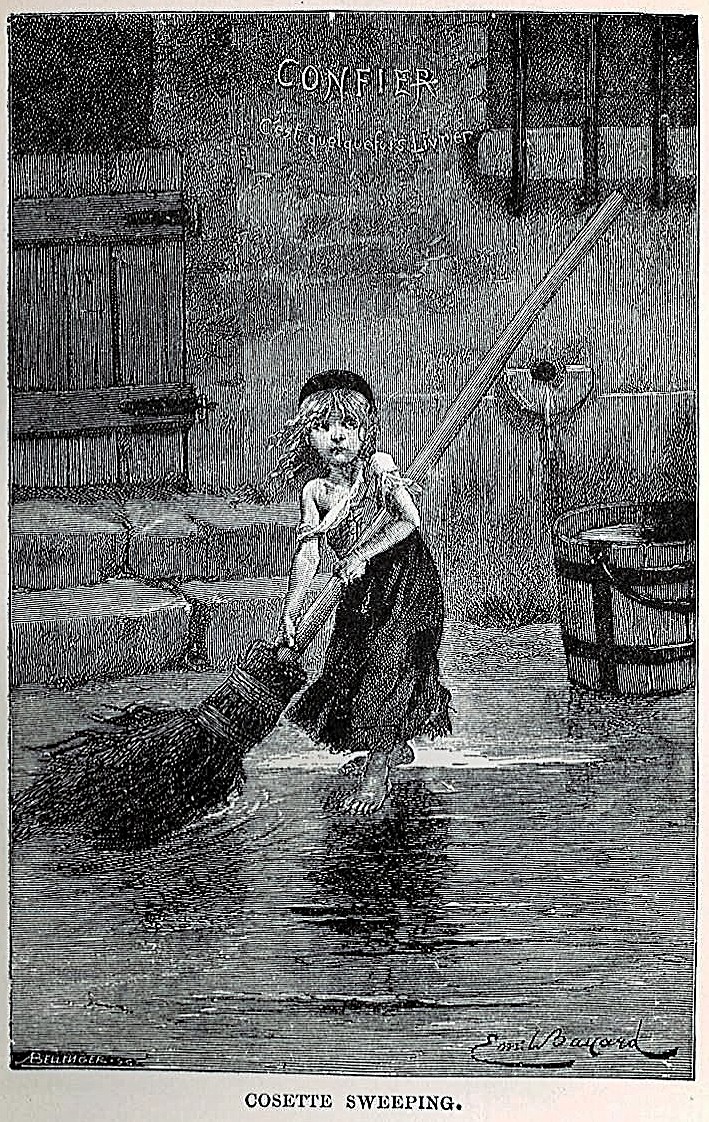
File:Ebcosette.jpgAs I sat and watched the film, I thought about how I react to an absence of moral fortitutude in my students. Do I take personal offense, or do I use the moment to teach, to redirect with grace and patience, like the Bishop Myriel does in the church with the still unredeemed Jean Valjean? When I catch a student lying, cheating, or being disrespectful, am I able to put away my own ego and see the good that still lies within, giving the student the chance to do the right thing, or do I condemn, punish, and put myself on a moral highground? We are teachers, not constables, and I hope that we can take these moments where students lose grip on the integrity that they are just now learning to develop as the teachable moments they are and teach with a reckless grace.
Now on the striaght and narrow, Jean Valjean uses his position of wealth and stature to rescue a woman and her daughter from the cycles of poverty and desperation that are all too familiar to our society today. He does more than donate to a cause or write a Senator. He inconveniences himself mightily and takes on the burden of the least of these, much as 1st cerntury carpenter calls his flock to do. How often have I had the chance to reach out to a student, to connect to a student, to pull myself out of the whirring of the everyday duties of the school day to do something extraordinary for the students I claim to care so much about? I am judged by my superiors through test scores and pedagogy, but if I am to be the teacher that in my head I think I should be, it will require something more. It will require a moment away from the class and away from teaching testable standards. I hope that I can be sensitive to these moments when they arrive. Jean Valjean didn't seek to force himself into being a hero, but when the moment called, he did not back down. I hope I can teach with the same reckless grace.
Lastly, what should we do with THAT student? We all have them. For Valjean it was Inspector Javert. Those students that seem to irk us the most, get under our skin, and leave our sighs longer and heavier each night as we get home are the ones who may need us the most. Being a good teacher to ALL students and really loving our enemies is not easy to do. It was not easy for Valjean to set Javert free, he knew it might be the end of him. But he knew it was the right thing to do. Luckily, our students are not grown men like Javert, who had been living in his set ways for decades, and was unable to respond positively to this act of reckless grace.  Our students are learning and developing, and ideally our patience, love, and guidance will be an example for them to follow. It should bewilder, confuse, but also light the path of what loving and teaching students in the classroom can look like.

Wednesday, January 2, 2013

The Elusive Art of Middle School Admiration or Why We Should Stop Worrying About What Middle Schoolers Think of Us

My desire to be liked others has reared it's ugly head over the past couple years of teaching 6th graders. Most good teachers want to be liked by our students while they learn, but finding the admiration of a Middle School mind comes at a cost, as the Middle School mind admires what is often not admirable. In a great National Geographic Article, I read about how the adolescent mind is chemically imbalanced and predisposed to connect to peers almost exclusively, to live in the moment, and to do what may seem foolish to the adult mind. Doing the responsible thing, having perspective toward the future, or having the desire to connect to minds older or younger than theirs are not what the Middle School mind is wired for.
My students show me that they are learning without too much pain and strife, but the selfish teacher in me wants them to learn while thinking I am funny, charismatic, and the coolest teacher ever. In time, I think I will be able to better connect to the average Middle School student, but as of now, my unofficial poll would tell me that most students would rank me in the neutral category. The National Geographic Article (and most of my interactions with Middle School minds) tells me that truly connecting to them is a treacherous mountain to climb. The students are too old to feel like they need me as an adult, as a younger student might, and too young to connect with me as an adult as a high school or college student might. The Middle School mind is tough on my desire to build relationships with the young people that I teach, but I am learning to understand them better with time. This makes me a better teacher and friend to my students. Often times the students' favorite teachers are the ones who don't make them do any work (as they often don't have the wherewithal to know that they need to be learning), or  the ones who are such distracting and unusual characters that they don't learn much in that class at all. But my need to connect to others wants me to be one of teachers (like I had in Middle School) who can skillfully connect to the students while learning along the way.
In truth, it is wrong to lump all Middle School minds together as I often do, because there are plenty of mature (and sometimes immature) students who do want to connect to the adults in their lives. But in my opinion, this lack of connection is more often the case than not.
One day at school, I was forced to use the student bathroom, which always proves to be an adventure in one way or another.With the desire to connect to students on the forefront of my mind, I found the above picture on the door of the stall. I covered up the one name on the list that could be read after my low-resolution picture had been taken to protect the innocent, but I thought this picture was the epitome of the confusion that characterizes the dichotomy of the Middle School mind. The teachers that some students hate (for whatever reason), are the very same teachers that other students love.
Of course, one has to take into consideration the students from which the teacher is receiving the admiration and vitriol, but no teacher who cares about kids wants to be on the "Teachers We Hate" list, no matter who says it. At the same time, we should all want to be on the "Teachers We Love" list. If this bathroom door poll shows anything, it is that we should not try too hard to be liked or hated by the Middle School mind, as we will probably end up on both sides of the list. Instead, we should center the learning around the students, be self-reflective in our teaching, and assume that all students can learn and achieve at a high level. The love and the hate will come with or without our trying to make them happen. Good teachers put their egos and desires to be liked to the side and do what is best for students, no matter what the Middle School students think of it inside their chemically imbalanced Middle School mind.